// // Leave a Comment

eset Nod32 Username and Password

Dont have antivirus, Click here to Download


1 Month Trial


Username:TRIAL-0116648867
Password:m8rftbt5h2


Username:TRIAL-0116648812
Password:8vkcu967j5


Username:TRIAL-0116647258
Password:aafc4jrefr


Username:TRIAL-0116654478
Password:9amunp8d5r


Username:TRIAL-0116652625
Password:j6hkvje2fc


Username:TRIAL-0116651070
Password:95ttf2jcd7
Read More
// // Leave a Comment

10 Ways to speed up your Windows 7

You don't have to live with a Windows 7 machine that's becoming unbearably slow. Here are 10 basic steps that will optimize system performance.

With Windows 7, Microsoft did a really good job making the system perform well. However, over time, Windows 7 systems can slow down and need some care and feeding to regain their former glory. Further, some Windows 7 features can be leveraged to improve overall system performance. In this article, I will outline 10 steps you can take to boost the performance of your Windows 7 systems.


1: Disable unnecessary services


Not every system service that is running on a stock Windows 7 machine is necessary. A number of services can either be disabled or modified to run only when needed. Once you make these changes, the service no longer has to consume system resources and the system no longer has to spend time starting the service. Earlier this year, I wrote an article here at TechRepublic titled 10+ Windows 7 services you may not need.


2: Reduce the number of startup items


Windows 7 systems eventually begin to suffer under the weight of software that is installed in the normal course of business. Many software titles install more than is necessary and include helper applications designed solely to make the software start up more quickly or facilitate other communication (e.g., iTunes helper). And new software installations might add a permanent presence to the system tray, even if it's not absolutely necessary for the system to function (Steam games, for example).

You could go through your system tool by tool and remove the offending software, but you might want to keep the underlying tool around and just prevent the helper from loading. This and more can be accomplished through the use of MSconfig, a tool that has long been a part of Windows. MSconfig allows you to selectively disable startup items and take other steps toward improving overall system performance.


To use MSconfig, go to Start and in the search box, type MSconfig. From the Startup tab (Figure A), you can disable items. Just be careful about what you choose.


Disable items to improve overall system performance.


3: Remove the bloatware installed by vendors


I've long felt that Microsoft's OEMs sometimes actively work against the Redmond behemoth and sully the company's name. Nowhere is this more evident than in the case of what has become known as "bloatware." In the never-ending race to the bottom of the PC market, lower cost PCs have had their profit margins bolstered by OEMs through the inclusion of mostly junk software - short-term trials and the like -- that does nothing but add a few dollars of profit while bringing performance to a crawl. Frankly, this is one of the reasons that I believe that Microsoft's Surface announcement, in which Microsoft noted that it would make its own device, is brilliant. The company needs to start with a clean slate in some ways (no pun intended).


If your PC shipped with a bunch of stuff you'll never use, get rid of that software. Generally, you can go to Start | Control Panel | Programs And Features (Figure B) and remove software you no longer plan to use. If the software adds items to the startup process, getting rid of it will make the PC start faster and, ultimately, perform better overall.


Use Programs And Features to remove unwanted software.


4: Keep viruses and spyware off your system


If you're running Windows, you need to be running an anti-malware program to keep viruses and spyware off your system. Nothing will ruin good performance like a boatload of spyware. My personal favorite (and free!) tool for combating malware is Microsoft Security Essentials. In my experience, it's been successful in catching bad stuff while not significantly degrading system performance itself.


5: Check your memory


How much RAM do you have? Is your system consuming all or most of your RAM? Does the system page out to disk? If so, you're suffering a massive performance hit, which can be solved by adding more memory to your PC. Greg Shultz explains how to do this by using Resource Monitor.


6: Go solid state


Solid state is all the rage these days, and with good reason. It's fast! More and more laptops and even desktops are moving to the technology because of the performance benefits. Solid state disks use memory cells from which data can be read very quickly, as opposed to the relatively plodding nature of rotational storage. By moving to SSD, you can give your Windows 7 system renewed life -- and give yourself a whole new user experience.


But SSDs can be expensive, so you need to be smart about how to use them in the most cost-effective way. See ZDnet's Windows 7 and SSDs: Trimming the fat from your system drive for tips on manking good decisions about how to implement SSD.


7: Ensure that power settings favor performance


This one is easy! When you're plugged in, configure Windows 7's power plans to favor performance over power savings. When you choose to use Windows 7' high performance power plan, you might increase the computer's performance in some (but not all) circumstances. It really depends on the kind of work you're doing and how often you allow the computer to sit idle.


To change power plans, go to Start | Control Panel | Power Options and choose your power plan settings (Figure C). For more about how these plans operate, see Evaluate the efficiency of Windows 7 power plan settings.


Go to Power Options to choose Windows 7 power plan settings.


8: Keep your system defragmented (unless you've followed item 6)


If you're using a traditional spinning disk in your Windows 7 system, you can keep your system operating at peak efficiency by periodically defragmenting the hard drive. If, however, you've opted to go with SSD-based storage, don't do this. First, you won't get any performance benefit and second, you'll significantly reduce the life of that expensive SSD.


Disk defragmentation is scheduled to take place once per week, but you can change this by going to Start | Accessories | System Tools | Disk Defragmenter (Figure D). In addition to changing the schedule, you can run an on-demand defrag from here. You can also run a defrag from the command line instead of from a GUI. Bill Detwiler's video explains how.


You can schedule a defrag in the Disk Defragmenter dialog box.


9: Disable or tune search indexing


Windows 7's search is good, but it can also affect system performance. If you really need to run a tool at full tilt, you can disable indexing altogether. Or you can tune the indexer to meet your specific needs, possibly reducing its overall impact on system performance.


10: Use ReadyBoost

Perhaps you don't want to jump into the solid-state game right away but would like some of the benefit that can be had from flash-based storage. Using nothing more than a USB stick, you can do so through a Windows 7 feature known as ReadyBoost. (Note that if you're already using an SSD as your system drive, ReadyBoost won't be available, since there would be no performance gain.)

ReadyBoost allows the system to make use of one of these speedy storage devices as a cache, improving overall performance of the system. The flash storage device that you choose to use for ReadyBoost should meet the following specifications set by Microsoft:


Capacity of at least 256 MB, with at least 64 kilobytes (KB) of free space

At least a 2.5 MB/sec throughput for 4-KB random reads
At least a 1.75 MB/sec throughput for 1MB random writes
Here's another nice feature: If Windows doesn't think ReadyBoost will provide a performance gain, it will tell you and won't let you enable it. In Figure E, you can see that I've opened the properties for a portable USB stick, which I've added to my Windows 7 system. However, Windows knows that the system disk is already fast enough, so ReadyBoost isn't available as an option. If you want to learn more about how to enable and configure ReadyBoost in your system, see Take a closer look at ReadyBoost features in Windows 7.
Figure E


ReadyBoost isn't needed for this system.
Read More
// // Leave a Comment

5 Ways to speed up your Windows XP

Everybody wants their computers to be as fast as new or even a little bit faster. That’s why a lot of users still prefer Windows XP - it’s a fairly light operating system and is particularly good for netbooks and older computers. Even though it’s pretty fast as it is, there are many ways to speed up XP even more - from upgrading your hardware (adding RAM is the easiest solution) to applying various registry tweaks. But if you are looking for a fast and easy solution, here are 5 simple tips which really help if you want to know how to speed up your computer running Windows XP.


1. Cleanup and defrag


Yes, I know, the good old cleanup and defrag. But seriously, you can’t expect your computer to be fast if it’s cluttered with junk and has file fragments scattered all over the hard drive.

Windows XP has built-in disk cleaner and disk defragmenter. To access the Disk Cleanup tool, go to Start –> (All) Programs –> Accessories –> System Tools –> Disk Cleanup. And if you want to use the Disk Defragmenter, go to Start –> (All) Programs –> Accessories –> System Tools –> Disk Defragmenter.
However, a lot of people prefer using third-party defrag utilities, like Auslogics Disk Defrag or Piriform Defraggler, because the built-in XP one is pretty slow and doesn’t do a very thorough job.


2. Uninstall programs you never use


A lot of people love trying out new software. So, they download programs, install them, run them a couple of times, and… sometimes never use them again! Sounds familiar, doesn’t it? Having too many programs can make your computer really slow, not to mention the amount of hard drive space they take up.
To see currently installed programs, go to Start –> Settings –> Control Panel –> double-click Add/Remove Programs. Review the list and uninstall programs you never use.


3. Optimize XP appearance settings

If speed is your top priority, it’s recommended to adjust XP appearance settings for best performance. Visual effects that we are so used to waste system resources. And if you think that it’s only the graphics card that has to deal with them, you’re wrong – CPU and RAM are affected as well.
Luckily it’s very easy to optimize XP for best performance by turning off unneeded visual effects:


  • Go to Start –> Settings –> Control Panel;
  • In the Control Panel click System and go to the Advanced tab;
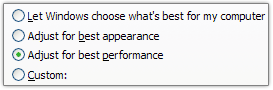
  • In the Performance Options window select Adjust for best performance;
  • Click OK and close the window.

This will turn off all visual effects, which is especially good for less powerful PCs and netbooks. But if you want Windows XP to look sleeker, leave the following boxes checked:


  • Show shadows under menus;
  • Show shadows under mouse pointer;
  • Show translucent selection rectangle;
  • Use drop shadows for icons labels on the desktop;
  • Use visual styles on windows and buttons.


4. Speed up Windows Explorer


If you feel that Windows Explorer takes too long to start, there is a way to speed it up. Windows automatically looks for network files, shared folders, and devices every time you open Explorer. Disabling this option will speed up access to Windows Explorer. To do it:


  • Open Windows Explorer;
  • Click on the Tools menu;
  • Then click on Folder Options;
  • Click on the View tab;
  • Find Automatically search for network folders and printers check box and uncheck it;
  • Click Apply, then click OK;

Reboot your computer.


5. Disable indexing


Indexing can be useful, but it can also make your computer slow and loud, as it takes up RAM and makes the hard drive thrash. The indexing service is used to update the lists of all files on your computer to speed up file search. Disabling indexing will make your search a bit slower, but overall it will speed up computer running XP. Here’s how:


  • Go to Start –> Settings –> Control Panel;
  • Double-click Add/Remove Programs;
  • Click Add/Remove Windows Components;
  • Uncheck Indexing Services;
  • Click Next and then click Finish.

To gain an even better speed improvement, you should consider using third-party programs, like Auslogics BoostSpeed. The program allows you to easily tweak hundreds of hidden Windows setting, as well as perform crucial system maintenance tasks to speed up your computer.
Read More
// // Leave a Comment

Top 5 File Sharing and Online storage Sites

When your email box doesn’t manage to send large files, it’s time for file upload sites, which will easily transfer all the files for share. Such “virtual trucks” as file sharing sites have similar working principles, but different advantages. So, we are going to inform you on the best file hosting sites online where you can share a file for free.


4Shared


4Shared.com gives you 15GB of free space at first. But you can get a premium account for 3-6-9-12 months at different prices. The process of sharing is very easy as there is a drag-and-drop window for your site.


The service has a mobile version for an easier access on the go. And you can search for different files, which means, that your documents may be found as well. So, it is ideal for a single-mission, non-private assignments.

Mediafire.com


Mediafire.com proposes you 50 GB for free. To get more space you can turn to various “Plans”: for 100, 200, 500 GB at a yearly price from $24.99 to 99.99.


This online service possesses web, desktop and mobile versions. The creators guarantee the security of your files and assure you, that their Internet-baby is perfect for sharing through social media. Besides, the interface is splendid and moving.


All in all, Mediafire is for modern people, who spend much time on social networks.


Mega.co


Mega.co will give you 50 GB for free and 4TB at $8,33 per month. Its main principle is the security of the files you have a right for.


The team of the creators has their own page, so you can get acquainted with those who keep your documents.


This site can be convenient for photographers and other people, who need to keep tones of high-resolution images somewhere.


Depositefiles.com


Depositefiles.com is a well-known file-sharing service, which lets you keep 25 GB of data for free.


To become a gold member you can buy an account for 1, 2, 6 or 12 months at a price of $11.95-74,95 for the period. Use discount coupons for profitable deals.


Use depositefiles.com if you need an easy access from home and office for your documents.


Streamfile.com


On Streamfile.com the free file-size limit is 300 MB. Except for a free account you can go Pro at a price of $49 per year and get 10 GB for a file or launch a business version for $599 yearly and enjoy loading 30GB-files.


This service is perfect, if you need some huge folders and zip files to be kept without having everyday access to them.
Read More
// // 1 comment

Idm Internet Download Manager Latest Version 7.1 With Crack Activated for whole life


Hey Guys..... Today I have got a Software for you, IDM latest version 7.1 Cracked.

I have seen many times that when people install idm it actually expires after 30 days, So there remains no way other then re-installing windows but don't worry, Today I am going to  Share a Cracked idm version. It is fully activated for lifetime.


How to Download:
1. First uncheck the box.
2. Then click on download.


Read More
// // Leave a Comment

How To Add Friends In Facebook Group With One Click


Hy Friends, in my last Facebook Tricks article I had told you that how you can invite all your friends to like facebook page at once.  Today I am Going to tell you an interesting trick on how you can add all your friends to a Facebook group at once. No need to worry Its 100% spam free. So lets see How to do it. Just follow these setups...


1. Go to Facebook.com

2 .Open the Group on which you want to add your friends.
3. Now if you are using Firefox press Ctrl + Shift + K and if you are on Chrome press Ctrl + Shift + J ( opere users: right click > Inspect Elements ).


4. Then go to Console and copy and paste below script into the Console. ( Click in the box below then press CTRA+A to select Script )

5. Press ENTER on your keyboard and wait till it add's all your friends.
Thank you for visiting, for more tricks plz subscribe and like us on Facebook.
Read More
// // Leave a Comment

How to add Related Posts widget With Thumbnails to blogger


Now here is wonderful hack for displaying links to related posts beneath each of your blog posts. The related articles are chosen from other posts in that same category/label/tag. With this hack many of your readers will remain on your site for longer periods of time when they see related posts of interest.


How to Add Related Posts Widget to Your Blog?


  1. Go to Blogger.
  2. Select your blog then go to  Template > HTML.
  3. Back up your existing Template before making any changes!
  4. Search for the </head> tag by pressing CTRL+F.
  5. Add the following code just before/above the </head> tag.
<!--Related Posts with thumbnails Scripts and Styles Start-->
<!-- remove --><b:if cond='data:blog.pageType == &quot;item&quot;'>
<style type='text/css'>
#related-posts{float:left;width:auto;}
#related-posts a{border-right: 1px dotted #eaeaea;}
#related-posts a:hover{background: #EEEEEE;}
#related-posts h2{margin-top: 10px;background:none;font:18px Oswald;padding:3px;color:#999999; text-transform:uppercase;}
#related-posts .related_img {margin:5px;border:4px solid #f2f2f2;width:100px;height:100px;transition:all 300ms ease-in-out;-webkit-transition:all 300ms ease-in-out;-moz-transition:all 300ms ease-in-out;-o-transition:all 300ms ease-in-out;-ms-transition:all 300ms ease-in-out;-webkit-border-radius: 10px;  -moz-border-radius: 10px; border-radius: 10px; }
#related-title {color:#666;text-align:center;padding: 0px 5px 10px;font-size:12px;width:110px;}
#related-posts .related_img:hover{border:4px solid #E8E8E8;opacity:.7;filter:alpha(opacity=70);-moz-opacity:.7;-khtml-opacity:.7}</style>
<script type='text/javascript' src='http://helplogger.googlecode.com/svn/trunk/relatedposts.js' />
<!-- remove --></b:if>
<!--Related Posts with thumbnails Scripts and Styles End-->
    6.  Now find the following Code, You may find it Twice, Stop at the second once.

<div class='post-footer'>
    7.  Just above it Copy and Paste the below Code.
<!-- Related Posts with Thumbnails Code Start-->
<b:if cond='data:blog.pageType == &quot;item&quot;'>
<div id='related-posts'>
<b:loop values='data:post.labels' var='label'>
<b:if cond='data:label.isLast != &quot;true&quot;'>
</b:if>
<b:if cond='data:blog.pageType == &quot;item&quot;'>
<script expr:src='&quot;/feeds/posts/default/-/&quot; + data:label.name + &quot;?alt=json-in-script&amp;callback=related_results_labels_thumbs&amp;max-results=5&quot;' type='text/javascript'/></b:if></b:loop>
<script type='text/javascript'>
var currentposturl=&quot;<data:post.url/>&quot;;
var maxresults=5;
var relatedpoststitle=&quot;<b>Related Posts:</b>&quot;;
removeRelatedDuplicates_thumbs();
printRelatedLabels_thumbs();
</script>
</div><div class='clear'/>
</b:if>
<b:if cond='data:blog.url == data:blog.homepageUrl'><b:if cond='data:post.isFirstPost'>
<a href='http://helplogger.blogspot.com'><img alt='Blogger Tricks' src='https://blogger.googleusercontent.com/img/b/R29vZ2xl/AVvXsEjz8f2rhEE5LbT1wIaujfiV3zfexFpd_vXE8BPtnqQpFoN2qWBl2Iq-aHX8emJJC7Av2uFTg47jO6G9x_eXLUf1vthS-r2-NLdIeQ6NFiqJZEdVb_uawbDjjAjmNL3luh1Q2WYusrGxARlq/s1600/best+blogger+tips.png'/></a>
</b:if></b:if><!-- Related Posts with Thumbnails Code End-->
  8.  In order to change the number of maximum related posts being displayed for each label, search for the code below (within the code given in step 7) and change the number "5" to any desired number.
max-results=5

And you have Done it.


Thank you for visiting, plz subscribe, If you hace any questions in mind regarding this post message me on Facebook.
Read More